How Decolonization Flows Into Workplace Spirituality

Decolonizing workplace spirituality is like a river fed by many tributaries. It does not arrive as a single, all-encompassing paradigm, but flows into a field through distinct currents that reshape its contours over time. When scholars introduce decolonizing perspectives into a discipline, they rarely replace the entire field. Instead, decolonizing theory enters through specific questions, methods, and critiques, influencing how knowledge is produced and how practice is envisioned. This metaphor of flow is especially helpful for understanding how decolonization integrates into workplace spirituality, a field already shaped by ethics, meaning-making, and critical inquiry.

Figure 1

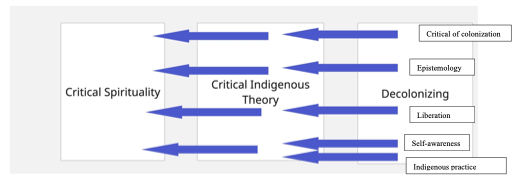
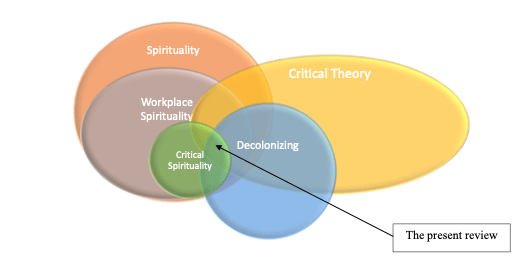
The “four rivers” framework provides a way to trace these converging currents. Developed thematically, it acts as the theoretical lens that defines the boundaries and features of a systematic literature search and supports the integrative review. The four rivers framework (Figure 1) demonstrates the Venn overlap among workplace spirituality, critical Indigenous theory (CIT), and decolonization (Figure 2). As a guiding structure, it organizes different research streams and clarifies how decolonial epistemologies and Indigenous spirituality challenge and enrich traditional workplace spirituality paradigms. Understanding the relationships among these frameworks lays the groundwork for the search criteria used in the systematic part of the integrative literature review.

Figure 2

Workplace spirituality scholarship has explored key themes like sustainability (Sulphey, 2022), organizational performance (Garcia-Zamor, 2003), and critical theory (Wolf & Feldbauer-Durstmüller, 2023). However, a focused review of decolonizing workplace spirituality has been noticeably missing. Integrative literature reviews are especially well-suited to addressing this gap. By reviewing, critiquing, and synthesizing existing research, integrative reviews create new knowledge and suggest innovative theoretical perspectives (Torraco, 2016). Their wide scope and inclusion of both empirical and theoretical sources enable scholars to identify patterns, tensions, and emerging trends across disciplines (Wade, 2020). Because of this, the integrative review is an ideal tool for examining the theoretical growth of decolonized workplace spirituality. This review aims not only to describe current research but also to highlight gaps, particularly in the critical analysis of colonial capitalism, and to suggest future paths for interdisciplinary scholarship.

The first aspect of the framework, challenging colonialism, draws directly from Decolonizing Theory’s roots in lived experience and social movements (Lechuga & Aswad, 2024). Decolonization promotes self-determination and opposes the normalization of colonial power structures within institutions (Marsh et al., 2015). In a scoping review of decolonizing nursing education, Rosario et al. (2024) identified the sociopolitical challenge of decolonization as a key obstacle to transforming professional fields. Similarly, in a critical thematic meta-analysis of communication studies, Lechuga and Aswad (2024) contend that decolonization requires political and ideological shifts that lead to material, tangible organizational change rather than symbolic or metaphorical gestures.

The second river, empowerment and emancipation, flows from this same source. Decolonizing Theory emphasizes material emancipation and collective self-determination, a theme echoed in critical organizational spirituality research. Lechuga and Aswad’s (2024) analysis underscores that redefining decolonization epistemically and politically must lead to reparative outcomes within organizations. Empowerment, in this sense, is not an individual mindset but a structural reorientation that redistributes voice, authority, and resources.

The third river, reordering knowledge, challenges dominant epistemologies that favor Western rationality while marginalizing Indigenous and relational ways of knowing. Decolonizing workplace spirituality requires organizations to acknowledge multiple epistemic traditions and focus on the spiritual, embodied, and communal aspects of work. This epistemic shift disrupts managerial models that commodify spirituality and instead emphasizes context, community, and ethical responsibility.

The fourth river, self-awareness, focuses on reflexivity and Indigenous practices as ways to foster transformation. Growing awareness of positionality, power, and historical context enables organizational actors to address colonial remnants within themselves and their institutions. Together, these four rivers form a transformative framework for decolonized workplace spirituality.

In synthesizing this theory, the present blog series examines how Decolonizing Theory, CIT, and critical workplace spirituality intersect. The framework that emerges reimagines the workplace not just as a site of productivity but as a relational, ethical, and spiritually grounded space where healing, justice, and sovereignty are actively advanced. By integrating spiritual consciousness with political awareness and relational accountability, decolonized workplace spirituality creates new opportunities for organizational change grounded in justice, mutual respect, and Indigenous sovereignty.

Decolonizing: From Theory to Material Change

Decolonizing is not a metaphor – it is an action.

It is work performed in real communities, on real lands, and within real systems of knowledge and power. As movements for Indigenous sovereignty and epistemic justice continue to grow, “decolonizing” must remain grounded in material change, relational accountability, and Indigenous-led praxis. What follows is an exploration of how decolonization reshapes education, ecology, and workplaces through participatory and relational practices rooted in Indigenous knowledge.

Decolonizing refers to material action informed by anti-colonial thought (Patel, 2015). It is not merely a theoretical critique; it requires transforming systems, redistributing power, and centering Indigenous authority. In research, decolonization involves supplementing dominant paradigms with Indigenous research paradigms that foreground relationality, responsibility, and community-defined priorities (Wilson, 2020). Within Critical Indigenous Theory (CIT), decolonizing action is foundational, even as CIT maintains productive tension between critique and the lived realities of Indigenous resurgence.

Ecology is one field where decolonization unfolds with clarity and urgency. Hernandez (2022) describes how decolonizing ecology restores relationships between people and land, emphasizing that Indigenous peoples hold deep, place-based knowledge encoded in dress, song, story, and ceremony. This knowledge is not anecdotal; it is ecological science embedded in lifeways. Cajete (1994) explains that living sustainably means recognizing the mutual responsibilities among humans, other living beings, and the landforms that shape our existence. Decolonization, in this sense, is a return to balanced relations grounded in biocultural stewardship.

Education is another critical arena for decolonizing praxis. Because education shapes the norms and values of Western societies (Crotty, 2015), Patel (2015) argues that educators must lead decolonizing efforts. Historically, schooling has functioned as a colonial project aimed at erasing Indigenous cultures and imposing the ideals of “whiteness.” A decolonizing approach reframes the so-called “achievement gap” as an “education debt” owed to all young people (Patel, 2015). Cajete (1994) calls for replacing objectivist teaching with relational, communal processes that honor the interdependence of learners, communities, and environments.

Smith (2021) documents 45 Indigenous-led research and education projects that exemplify decolonizing methodologies, including reframing, networking, claiming, and deep remembering. These projects demonstrate that original knowledge can be developed rigorously through relational accountability rather than through colonial segmentation of experience. For Cajete (1994), the Earth itself is the primary educator, and human teachers are guides who help students perceive, interpret, and care for the natural world.

Because of its power, decolonization is often misappropriated in academic discourse. Lechuga and Aswad (2024) warn against using decolonization as a metaphor detached from material realities. Genuine decolonization dismantles colonial systems and returns land, power, and agency to Indigenous peoples. It transforms governance, research practices, and social relations.

Across fields, scholars describe how decolonization reshapes praxis. In school psychology, Grant et al. (2022) identify processes such as decentering Whiteness, rejecting deficit narratives, and expanding methodologies to include Indigenous knowledge. A scoping review of health education research by Narasimhan and Chandanabhumma (2021) highlights three essential elements: structural and self-reflection, action-oriented engagement, and leadership grounded in Indigenous worldviews. In health and education, Rosario et al. (2024), Marsh et al. (2015), and Mills et al. (2018) advocate for Indigenous-led research that centers healing, sovereignty, and epistemic justice.

Decolonization also extends into organizational and management contexts. Banerjee (2022) proposes a decolonial management theory that challenges Western epistemic dominance and rejects tokenistic contextualization. This work acknowledges that Western and Indigenous paradigms are often ontologically incommensurable and that honoring Indigenous sovereignty requires more than simply “adapting” existing models.

Praxis is the heart of decolonization. It must be participatory, grounded in local communities, and materially redistributive (Lechuga & Aswad, 2024). Research by Fangupo et al. (2023) and Doyon et al. (2021) shows that decolonizing requires rethinking tools, accountability structures, and institutional hierarchies to honor Indigenous authority.

Self-awareness and reflexivity form an essential stream within decolonizing theory. A review of decolonizing nursing shows racial decentering of Whiteness, achieved through diverse partnerships, as a crucial action (Rosario et al., 2024). Awareness of language (Mathaba, 2023) and intersectionality (Grant et al., 2022) deepen reflexivity. Literature reviews (Doyon & Boron, 2021) and empirical studies (Marsh et al., 2015) show that transparency and critical self-examination disrupt privilege and foster decolonizing practices. As Mathaba (2023) suggests, cultivating intellectual curiosity and disruption fosters reflexivity (Grant et al., 2022).

Decolonization spreads across engineering, ecology, education, statistics, social work, health, and beyond. Emerging work, including new theorizing on decolonizing workplace spirituality, shows how relational accountability and Indigenous-led praxis can transform not only knowledge systems but the institutions we build and inhabit.

Decolonizing is an action. It is community-rooted, relational, and accountable. It calls us all to rebuild our worlds on foundations of justice.

Indigenous Wisdom as Critical Theory

Critical Indigenous Theory (CIT) brings Indigenous relationality, responsibility, and sovereignty into conversation with Western thought.

As an intellectual tradition, critical Indigenous theory (CIT) does more than critique dominant systems; it reorients how we think, research, teach, and lead. Rooted in Indigenous epistemologies and land-based relationality, CIT offers an alternative to Eurocentric assumptions about knowledge, power, and human flourishing. This essay introduces key themes in the literature and highlights how Indigenous knowledge transforms scholarship and public life.

CIT begins with the recognition that Indigenous knowledge systems carry thousands of years of accumulated wisdom. Cajete (1994) emphasizes that the teachings of global Indigenous peoples form “a vital storehouse of… wisdom” (p. 77) that must be preserved, protected, and activated in contemporary contexts. While critical theory emerged in Austria and interprets reality as socially constructed through systems and power structures (McArthur, 2022), CIT works through decolonization, naming, and reversing the historical erasure of Indigenous intellectual traditions (Smith, 2021). In this sense, decolonization is not an abstract metaphor—it is the re-centering of Indigenous knowledge, followed by a careful and ethical incorporation of Western knowledge. As Wilson (2020) notes, relationality is the heartbeat of Indigenous thought, shaping how knowledge is created, evaluated, and shared.

Because colonization has been a global project, Indigeneity is a worldwide condition. Indigenous peoples exist in nearly every nation-state (Hernandez, 2022), and they steward an estimated 80% of the world’s biodiversity (Smith, 2021). Across continents, trans-Indigenous networks work toward justice, ecological protection, and cultural resurgence. Indigenous scholars in North America, Oceania, South America, and Europe contribute to this movement by advancing research and pedagogy grounded in sovereignty, community accountability, and relational ethics.

Bujaki et al. (2023) articulate CIT through three interconnected dimensions: an ontology of relationality, an epistemology grounded in experiential and land-based knowledge, and an axiology rooted in responsibility and accountability. Their review of accounting scholarship demonstrates how Western research traditions marginalize Indigenous voices and metrics, and how Indigenous values can guide methodologies committed to social transformation. Rather than fitting Indigenous peoples into Western categories, CIT demands a reordering of research around Indigenous priorities.

Other scholars highlight CIT’s focus on reflexivity and structural change. Ufodike (2025) advocates for moving away from traditional academic exclusion toward methods that emphasize Indigenous agency and diversity. Vass and Adams (2021), working in the field of Indigenous health, critique settler educators’ limitations and advocate for anti-racist training rooted in self-reflexivity. Likewise, Garcia and Shirley (2012) demonstrate how critical Indigenous pedagogy promotes cultural reclamation, community unity, and political awareness among students.


Methodologically, CIT challenges extractive research practices by treating research as a relationship. Hayman et al. (2017) demonstrate this through their work with the Carcross/Tagish First Nation, where a “deep chart” weaving oral narratives with digital mapping counters colonial cartography. Their multimodal approach enacts relational accountability by centering Indigenous storytelling and community priorities.


Across these examples, CIT emerges as a transformative theory. It rejects tokenism and insists that Indigenous standpoints are not supplementary; they are essential. CIT reconfigures research, teaching, and leadership by centering sovereignty, land, and community-defined responsibilities. It is an epistemological and ethical shift rather than a representational one.

Four Rivers Framework

The synthesis in this current post also shows how CIT converges with broader decolonizing theory and critical workplace spirituality. Four “rivers” unite these traditions: resisting colonialism, advancing empowerment, reshaping epistemology, and cultivating self-awareness through Indigenous practices. Together, they reimagine the workplace as a relational and ethical space rather than merely a site of productivity. Decolonized workplace spirituality foregrounds community, embodiment, and critical reflection; it honors Indigenous knowledge systems and invites organizations to pursue justice, healing, and sovereignty. When spiritual consciousness is woven with political awareness and relational accountability, organizations can move beyond colonial residues to become places of liberation, self-determination, and meaning-making grounded in mutual respect.

In this way, CIT is not only a scholarly framework but also a pathway toward transforming institutions, communities, and the very foundations of knowledge itself. Stay tuned next week as we explore each of the four rivers that link decolonizing to CIT and organizational/workplace spirituality.

What Happens When Work Becomes Sacred?

What if workplaces treated meaning, connection, and compassion as essential to productivity?

Emerging research on workplace spirituality suggests that when organizations nurture employees’ inner lives (not as a marketing strategy but as an ethical commitment), burnout decreases, trust grows, and productivity becomes more sustainable. This essay synthesizes current scholarship to help human resources development (HRD) and organizational leadership professionals evaluate how spiritual well-being, when authentically approached, can support healthier, more ethical workplaces.

Workplace spirituality includes internal experiences of meaning and purpose as well as organizational structures that support connection, community, and ethical alignment (Garcia-Zamor, 2003). Although spirituality often overlaps with religion, the two are not synonymous; spirituality can flourish outside formal religious systems (Dent et al., 2005; Walach, 2017). At its core, workplace spirituality emphasizes the quest for meaning and transcendence within daily work, a factor increasingly recognized as essential for employee well-being and organizational effectiveness.

A growing body of evidence links spirituality with productivity, organizational commitment, and employee satisfaction. Garcia-Zamor (2003) argues that spiritual well-being enhances performance, not by pressuring employees to work harder, but by fostering a sense of purpose and integrity in work. Wagner and Gregory (2015) found that spirituality strengthens organizational commitment and communal bonds, which are crucial buffers against burnout. Golden et al. (2004) likewise demonstrate that spirituality significantly reduces burnout even when controlling for personality and work environment, suggesting that spiritual well-being offers a unique protective effect.

Burnout

Duchon and Plowman (2005) further define workplace spirituality as the recognition and nurturing of inner life through meaningful work in a supportive community—a definition they propose twice to emphasize its centrality. This perspective aligns with Daniel’s (2015) argument that workplace spirituality enhances transcendence, connectedness, and community, all of which contribute to long-term job satisfaction. Meaningful work, in particular, significantly decreases work stress across cultural contexts, underscoring how purpose is not a luxury but a psychological necessity. For professionals in high-intensity or trauma-exposed fields—including counseling, nursing, and human services—workplace spirituality offers measurable benefits. Counselors facing vicarious trauma report restored meaning through spiritual practice (Pirelli et al., 2020). High spiritual well-being correlates with lower burnout among critical care nurses (Kim & Yeom, 2018). Intentional spiritual cultures also reduce turnover intention and deepen satisfaction, creating conditions for stable employment and collaborative learning (Carroll et al., 2014; Dirkx, 2013). Research by Lata and Chaudhary (2021) further suggests that spirituality improves interpersonal dynamics at work, reducing conflict and strengthening relational trust.

Yet workplace spirituality is not automatically liberatory. Scholars caution that spirituality becomes harmful when appropriated as a tool of managerial control or a “feel-good” shortcut to productivity (Fenwick & Lange, 1998). Ul-Haq (2020) argues that capitalism often hijacks spirituality to advance performative goals while ignoring the deeper ethical and communal dimensions that make spirituality transformative in the first place.

Epistemology: What do you count a realy knowledge?

A critical and decolonizing lens reveals how organizations can move beyond shallow or commodified uses of spirituality. Colonial capitalism has historically suppressed diverse epistemologies and marginalized Indigenous knowledge systems (Khan & Naguib, 2019). Integrating Indigenous forms of spirituality, as Ul-Haq (2020) recommends, can foster more humane workplaces. Pavlovich and Corner’s (2014) case study demonstrates how spiritual practice enabled an entrepreneur to collaborate with Indigenous communities, preserve traditional craft knowledge, and support local economic development. Her approach aligns with Thomas and Gion’s (2021) concept of Nation Building, which emphasizes self-determined community thriving. Decolonizing workplace spirituality requires organizations to embrace ethical pluralism and community-centered leadership. Lechuga and Aswad (2023) show that decolonization reshapes organizational life by valuing Indigenous epistemologies and meeting the needs of historically marginalized groups. Brooks and Ezzani’s (2021) triadic framework—critical consciousness, critical resistance, and critical love—illustrates how culturally grounded spirituality can support justice-oriented leadership and ethical resistance within organizations.

For HRD and organizational leadership professionals, the research is increasingly detailed: when workplaces nurture meaning, connection, and compassion, employee well-being and organizational outcomes improve. The same is true for anyone who helps lead a community group or a family. But spiritual practice must remain ethically grounded, culturally responsive, and protected from commodification. When approached with integrity, workplace spirituality becomes not only a catalyst for productivity but a foundation for ethical leadership and sustainable organizational flourishing.

What spiritual practices do you use to bring sustainability, flourishing, or productivity? Leave a comment and tell me about them!

Defining Spirituality: Meaning, Connection, and Healing

What does “spirituality” really mean beyond religion or belief?

 For many, spirituality immediately brings to mind ritual practices or doctrinal faith. However, spirituality is much broader, more human, and more universal than any single tradition. It is a process of creating meaning, forming connections, and personal growth. Its a way of exploring the deeper aspects of life. For general readers, interfaith audiences, and educators, viewing spirituality as a human experience helps explain why it matters not only for personal well-being but also for the health of our communities and institutions.

A spiritual experience can move a person beyond the limits of ego and immediate concerns, opening them to new forms of insight (Walach, 2017). Spirituality is different from religion, yet it often rests at the core of religion. Florczak (2010) describes spirituality as the human process of finding meaning in life’s events, building connections with others, and experiencing moments of transcendence. These themes (meaning, connection, peace, and purpose) appear across cultures and faiths, and even among those without religious identity. Spirituality also influences motivation, commitment, and adaptability in individuals and organizations (Jurkiewicz & Giacalone, 2004). It links people to purpose, others, and a deeper understanding of themselves (Wachholtz & Rogoff, 2013). Spiritual growth can increase peace, self-awareness, and emotional clarity (Strawn & Hammer, 2013). Although scholars recognize that spirituality resists strict definition (Ul-Haq, 2020), it consistently points to an inner journey rooted in meaning and connection.

Understanding how spirituality develops helps clarify its role in well-being and community. Spirituality unfolds gradually as individuals explore themselves and their context, discovering pathways to healing and interconnection (Fenwick & Lange, 1998). Conn (1999) describes spiritual formation as a lifelong process supported by guidance, discernment, and practices tailored to a person’s health and developmental stage. Because psychological health and spiritual development intertwine closely (Barnby, et al., 2015), nurturing spirituality often benefits emotional life as well. McSherry (2000) and Walach (2017) highlight that spirituality can be taught—cultivated through intention, discipline, and support—just as much as it can arise spontaneously. Goldstein (2007) demonstrates that individuals who learn to cultivate sacred moments experience increased peace, positive emotion, and improved relationships.

Spirituality deepens in community. It takes time to develop within oneself and then radiate outward (Burkhart & Hogan, 2008). In groups or dyads, one person may initiate a spiritual encounter, creating a shared experience that reinforces meaning. Positive spirituality strengthens coping, as seen in women with gynecological cancer who reported stronger resilience when supported by spiritual meaning and connection (Boscaglia et al., 2005). Yet spirituality is not always comforting. When spirituality is marked by uncertainty or by an insecure attachment to the divine, it may correlate with anxiety and depression (Wuthnow, 2001). Conversely, a secure, meaning-centered spirituality correlates with reduced distress and stronger emotional well-being (Boscaglia et al., 2005). Spirituality thus functions as a purposeful, often guided experience of inner formation that can improve both mental and physical health (Burkhart & Hogan, 2008).

A growing body of research demonstrates spirituality’s relationship to mental health, connection, and community. Changes in spirituality and mindfulness correspond with improved mental health outcomes (Greeson et al., 2011). When workplaces recognize and support employees’ inner lives, teams strengthen their connections, leadership becomes more decisive, and productivity improves compared to control groups (Duchon & Plowman, 2005). Spirituality can also shape how individuals experience psychiatric treatment, often softening distress and enhancing healing (Vanderpot, 2014). There may even be an inverse relationship between spirituality and physical pain (Wachholtz, et al., 2007). Practices such as forgiveness, positive coping, and community connection can reduce depression in adolescents (Desrosiers & Miller, 2007). Overall, spirituality plays a powerful role in mental health, including in contexts of burnout and vicarious trauma, even though physical health effects remain mixed.

For those seeking deeper meaning, stronger well-being, and more connected communities, spirituality offers more than belief—it offers a path. By nurturing spiritual depth, individuals and groups cultivate peace, resilience, compassion, and a shared sense of purpose. In an increasingly fragmented world, spirituality reminds us of what holds us together. Where have you experienced moments of meaning, connection, or transcendence in your own life, and how have those moments shaped your well-being or relationships? If spirituality is fundamentally about meaning and connection, what might it look like for our communities or workplaces to intentionally nurture those dimensions?

When Workplace Spirituality Becomes Manipulation

Many organizations offer “spiritual wellness” programs that soothe but never transform.

In workplaces seeking solutions to burnout, conflict, and disconnection, spiritual language has become an attractive tool. However, when spirituality is used to comfort employees without addressing the structures that harm them, it risks becoming just another way to uphold the status quo. This essay reveals how corporate spirituality can hide systemic harm, reinforce profit-driven hierarchies, and silence deeper calls for justice. True spirituality must challenge, rather than soften, unjust systems. Managers, educators, and faith-based organizations have a crucial role in making a difference.

For many workers, spirituality provides a cushion against the pressures and dangers of modern work. It can help reduce inner fatigue, isolation, and a sense of meaningless work (Jurkiewicz & Giacalone, 2004). However, these advantages often fall short when spirituality is used for profit rather than well-being. Workplace spirituality programs may be implemented in superficial, unhelpful, and neoliberal ways (Driscoll & Wiebe, 2007), focusing more on appearances than real change. Human resources development (HRD) departments sometimes promote spirituality that makes employees feel good while ignoring underlying issues. Spirituality is used as a cover for problems like overwork, inequality, and poor management (Fenwick & Lange, 1998). In such cases, spirituality becomes a way to mask dissatisfaction so employees can return to work more obedient, calmer, and more productive.

Indeed, workplace spirituality is often justified by its ability to enhance productivity (Garcia-Zamor, 2003), even though financial gain has no place in accepted definitions of spirituality. This dynamic reveals a deep tension. Some scholars argue for a form of spirituality that challenges capitalism’s extraction and competition (Bell, 2008) and encourages organizations to prioritize people and values over profits (Agbim et al., 2013). The question for today’s leaders is clear: Are we using spirituality to maintain the system or to challenge it?

This distinction lies in the difference between technical and critical workplace spirituality. Technical spirituality involves “going through the motions,” offering feel-good practices without fostering deeper change, while critical spirituality genuinely seeks to “explain all the circumstances that enslave human beings” (Wolf & Feldbauer-Durstmüller, 2023). Brooks and Ezani’s (2021) case study of a private Islamic school shows how a leader’s critical spirituality can shape leadership practices rooted in social justice, gender justice, and pluralism. Their framework, grounded in critical consciousness, reflection, and love, illustrates how spirituality can serve as a force for equity rather than mere compliance.

Shah’s (2022) ethnography of justice-focused educators further develops this idea. Using a spiritual dialogic approach that encourages trust and vulnerability, educators incorporate spirituality into justice work. Although not explicitly connected, Duchon and Ashmos’ (2005) framework of workplace spirituality, focused on relationships, inner experiences, and meaning, underpins Shah’s findings. Here, spirituality enhances understanding of self and community; promotes healing through relational spaces; fosters embodied, reflective engagement; and sees interconnectedness as a core element for professional growth.

Critical spirituality extends beyond organizational frameworks to personal healing. It promotes deep reflection on meaning (Bell, 2008) and places trauma within its social context. Healing occurs through collaborative, reflective processes that foster agency and connect personal and social justice (Gardener, 2022). Wolf and Feldbauer-Durstmüller (2023) demonstrate how this form of spirituality opens up space for alternative management practices by blending spiritual, ethical, and critical perspectives.

These approaches differ significantly from technical spirituality, which maintains hierarchical boundaries and discourages authentic connections across levels of power (Driscoll & Wiebe, 2007). Decolonized workplace spirituality, however, promotes connection across hierarchical and environmental boundaries (Payne & Calton, 2004; Cajete, 1994).

The final theme focuses on resisting colonial capitalism. Although capitalism varies greatly, it fundamentally depends on private profit and wage labor (Harris & Delanty, 2023). Ul-Haq (2020) argues that capitalism has hijacked workplace spirituality to promote productivity, and instead calls for Indigenous spirituality to create humane workplaces. Fenwick and Lange (1998) observe how corporate spirituality often exploits human desire, offering a “hurry-up-and-feel-good” version of spiritual life that avoids struggle. Colonial violence (Khan & Naguib, 2019) has long suppressed Indigenous wisdom, but this wisdom could be essential for healing and dismantling oppressive systems (Ul-Haq, 2020; Gonzalez, 2016).

For managers, educators, and faith-based leaders, the challenge is to reject comforting spiritual facades and adopt transformative, justice-focused spirituality. Only then can workplaces become places of liberation instead of tools of harm.

Have you ever seen spirituality “misused” in work or another organization? Leave a comment below and tell me about it!

The Perilous Workplace: Why Burnout Isn’t Just About Stress

Modern work drains more than time, it depletes spirit. Burnout, stress, and workplace toxicity are not personal failings but symptoms of deeper structural imbalance. For those who care for others (clergy, HR professionals, social workers, etc.) and for workers who are barely holding on, spiritual disconnection at work may be saying something urgent: something larger needs healing.

The contemporary workplace is full of peril. Livelihoods can be won and lost in an increasingly competitive environment, and interpersonal conflict often shapes the emotional texture of the workday. Personality clashes between colleagues, employees, and managers create worry, tension, and disruptions to workflow (Lata & Chaudhary, 2021). Added to this are excessive demands: heavy workloads, unyielding deadlines, and escalating performance expectations that easily become too much to bear. These patterns frequently lead to stress, burnout, and diminished job satisfaction (Altaf & Awan, 2011). For clergy carrying congregational grief, HR professionals supporting employees in crisis, and workers in emotionally demanding roles, burnout (Gabassi et al., 2002; Wachholtz & Rogoff, 2013) and vicarious trauma (Jankoski, 2010) can feel like inevitabilities rather than risks. When these conditions culminate in turnover, career disruption, and exhaustion (Lyons & Bandura, 2020), the financial costs only compound the personal pain. Stress contributes to higher healthcare use, absenteeism, and employee turnover, further affecting both workers and the organizations that rely on them (Daniel, 2015).

With burnout rates rising across professions (Ul-Haq, 2020), many are asking whether the problem lies not within individuals but within the structures and cultures that shape modern work. Many economic sectors operate in ways that are extractive (Crossman, 2011) or even combative (Hernandez, 2022), producing a widespread sense of purposelessness. Workers may feel that they are expending their lives in systems that reward productivity but neglect humanity. For clergy, this dissonance can feel deeply spiritual; for HR professionals, it can reveal institutional misalignment; for burned-out workers, it often resembles grief.

Spirituality is often touted as an antidote to these pressures. Research suggests that spirituality can counteract inner fatigue and restore a sense of meaning (Jurkiewicz & Giacalone, 2004). Yet spirituality itself can be misused. Some workplace programs remain superficial or even manipulative, offering inspirational slogans without addressing harmful structures (Driscoll & Wiebe, 2007). HRD initiatives sometimes promote a version of spirituality designed to make workers “feel good” rather than confront systemic problems (Fenwick & Lange, 1998). While workplace spirituality can improve productivity (Garcia-Zamor, 2003), financial gain is not the measure of a truly meaningful spiritual environment. Scholars increasingly argue for a workplace spirituality that challenges the extractive and adversarial logics of capitalism (Bell, 2008) and fosters organizations that place people and values above profit (Agbim et al., 2013).

Spirituality’s potential impact extends beyond morale. Greeson et al. (2011) show that spiritual and mindfulness practices correlate with improved mental health. When workplaces affirm employees’ inner lives, teams display stronger cohesion, clearer leadership, and enhanced effectiveness (Duchon & Plowman, 2005). Spirituality also shapes the experience of mental health treatment itself (Vanderpot, 2014) and may be inversely related to experiences of physical pain (Wachholtz et al., 2007). Spiritual practices such as forgiveness and positive coping can reduce depression (Desrosiers & Miller, 2007). These findings matter deeply for burned-out workers and the professionals who support them.

Further, spirituality has been shown to increase workplace performance (Garcia-Zamor, 2003) and strengthen commitment and purpose, qualities whose absence often fuels burnout (Wagner & Gregory, 2015). Even when controlling for personality and work conditions, spirituality significantly mitigates burnout (Golden et al., 2004). Duchon and Plowman (2005) describe workplace spirituality as an environment that honors employees’ inner lives and nurtures them through meaningful work within community.

Spiritual well-being also reduces vicarious trauma and restores connection. Among critical care nurses in South Korea, high levels of spiritual well-being correlate with lower burnout (Kim & Yeom, 2018). Intentional spiritual practices at work increase organizational commitment, enhance job satisfaction, and reduce turnover intention (Carroll et al., 2014).

For workers who feel hollowed out, for clergy carrying others’ pain, and for HR professionals seeking healthier organizations, the message is clear: our exhaustion is not a personal flaw. It is a sign that something essential—our spirit, our meaning, our connection—needs tending. And when workplaces honor the inner life, healing becomes possible not only for individuals but for the systems that shape our collective work.

Introducing…….

Speaking or writing about spirituality is foolishness. The moment words are used to describe the phenomenon, one is moving away from the experience. Spirituality is ineffable. And still….

Spirituality is a vital component of the human experience. An individual’s spirit is a key ingredient in action, from the heroic to the mundane. 

Spirituality is a source of peace, inner strength, and integrity. Individuals use spiritual practices, such as silence, meditation, sacred readings, and other practices, to bring alignment to their body, mind, and soul. Buddhist monks, the Dalai Lama, and Thich Nhat Hanh, famously drew on their spirituality to resist and endure persecution. At the same time, Christian mystics Thomas Merton and Martin Luther King Jr. empowered them to create peace and justice. More to the point, many people know a grandparent, cousin, or family friend who has relied on spirituality to see them through a difficult season. Individually, each of us engages our personal spirituality somehow to get through the day.

I want to introduce you to another form of spirituality. Organizational spirituality (also called workplace spirituality) describes how spirituality and spiritual dynamics operate within a group. The group could be a family, a cultural or religious group, or a workplace. A simple example of organizational spirituality is the exuberance at a sports event. Organizational or workplace spirituality also occurs when a safe group of people fosters growth and healing. 

The following series offers a fresh scientific look at workplace spirituality by synthesizing what researchers have already discovered and asking where the field is headed next. One area gaining attention is the role of decolonizing theory, which offers new ways to think about what spiritual integrity, belonging, and meaning can look like within a group.

By weaving together a wide range of studies, this project will highlight how scholars are beginning to envision a more decolonized approach to organizational spirituality, one that challenges old assumptions and creates space for diverse worldviews. Along the way, I will identify what we know, where the gaps are, and why those gaps matter. Ultimately, the goal is to point toward future directions for research and practice, especially for those working in human resource development, adult education, and organizational leadership. Understanding organizational spirituality in more expansive and inclusive ways can deepen our insight into organizational culture, employee well-being, and the possibilities for more just and grounded workplaces.

I expect a 600-word post on my organizational spirituality research to drop every week. Please follow along, share with a friend, and leave a comment.

Church: The Ugly

Intro: Have you ever been in a situation that gets ugly? Maybe it’s a breakup, or a fight. A NASCAR wreck or classic Jerry Springer episode. When things get ugly they aren’t good, that’s for sure. They’re too compelling to be ‘bad’ in a traditional sense. Ugly is part of a different continuum than good-bad. Ugly belongs on a spectrum with beauty. In a perfect form, ugly provides the photo-negative of beauty. We’ve seen the good and the bad. Now it is time to see Church: the Ugly.

When John is baptizing by the Jordan, some Pharisees come to see him. They seem to be engaged in an argument regarding the source of authenticity. John is calling people to repentance and people are coming to him and confessing their sins, then undergoing a ritual bathing in the Jordan River (Matt 3:1-6). He indicates the source of authenticity is the inner drive toward repentance. Without his visitors even speaking, John contrasts the authenticity of his movement with the imagined argument of an appeal to authority as the sign of God’s Spirit and salvation (Matt 3:7-10). John’s prophecy about the end of their movement was partially correct. The temple was destroyed and the movement they persecuted became the world shaping Church. John advocates for God’s people being rooted in something more primal than organized religion: a personal interaction with the Spirit that leads to comprehensive balance. Religious power rooted in Empire will fall away.

The Apocalypse is a common element in many sacred stories. The Greek root of the word refers to an uncovering or a truth telling. For the last few millennia, that uncovering has been understood to entail also a destruction of the world as we know it. One could reasonably assume those who crafted most of the world’s religions understood that Deep Truth leads to the undoing of the human world as we know it. Sometimes it seems this has happened in a large way. The collapse of the Bronze Age, the genocide of the Indigenous Peoples of North America, and the Roman conquest of Gaul are a couple of examples of times where the world order collapsed for a large group of people. These sorts of times are uncertain, surprising, and often frightening.

Tears. Cry or grief feeling

Many of us have had a similar personal experience. A discovered affair reveals the ‘true state’ of a marriage. A job suddenly or unfairly ends and one discovers the parts of self that had atrophied under its weight. A sports team loses a game, or political party loses an election. One might wonder how could this happen, even though it happened honestly and must be reckoned with. This is an apocalypse. Faith, the love that powers it, and the hope that leads us on are three important tools for not only weathering the apocalypse but also making good use of it and rejoicing over it.

Where is the church in all this? The Christian faith has survived through a couple of apocalypses. Many in decision-making capacity feel it can weather this one in some form. As I have written about previously, the church has, for better and worse, crafted the world order we experience today. Outside of a few publicly nuanced stances, most religious organizations don’t say much different than one might expect to read in the New York Times, or hear on Fox News. Only the places where the Church has something unique to say or do will survive the next apocalypse. It will be ugly.

John’s Revelation (18:9-10) describes the kings of the earth who cry out at the apocalypse “Alas, alas, the great city, Babylon, the might city! For in one hour your judegment has come.” Theologian Wes Howard-Brook reinterprets the passage this way…

Fallen, fallen is the global economy! For all peoples have drunk from its alluring cup, and the one percent have grown rich form the power of its luxury… And then I saw the corporate elite wailing and weeping, crying, “Also, our markets are no more!” And the banksters and their companions broke out in terrible lament, as all upon which they relied was no more… Alas, Amazon and Starbucks, Microsoft and Costco are no more! All the endless items available at a click will never be found again!” (pg. 297)

There are many material assets that embody the hopes and dreams of many generations that will be either given away or taken through attrition and corruption. I pray they are given to the inheritors of the great story of faith, regardless of their creed or affiliation. We are each a character in the story of Good Faith.

Sometimes a faith community is an amazing asset for weathering a personal apocalypse. Sometimes it is not all that one needs to grow through the trauma and crisis. Each of us can nurture the flame of our spirit. When it’s ugly out there and one is alone, they must be able to take responsibility, with God, for our own spiritual life and experience. When our church cannot provide all that we need, God will through grace. This may come in the form of a spiritual director, a good friend, or healing time spent in solitude.

This concludes a look at the Church: the good, the bad, and the ugly. Many great attributes of our world are because of the church. Much has happened in the name of the church antithetical to her stated mission. According to the Church’s own rhetoric, much of what currently composes the institution, the visible church, will fall away with the next apocalypse. What will survive is a remnant of people who know the story, know who they are, and can be about God’s business. This could be you.

***

Let me know what you think. Does Good, Bad, or Ugly resonate with you when you think about the Church or organized religion? Do you feel prepared for a personal or social apocalypse? Please leave a comment, subscribe, and share.