Decolonizing workplace spirituality is like a river fed by many tributaries. It does not arrive as a single, all-encompassing paradigm, but flows into a field through distinct currents that reshape its contours over time. When scholars introduce decolonizing perspectives into a discipline, they rarely replace the entire field. Instead, decolonizing theory enters through specific questions, methods, and critiques, influencing how knowledge is produced and how practice is envisioned. This metaphor of flow is especially helpful for understanding how decolonization integrates into workplace spirituality, a field already shaped by ethics, meaning-making, and critical inquiry.
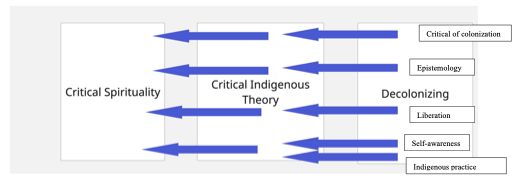
The “four rivers” framework provides a way to trace these converging currents. Developed thematically, it acts as the theoretical lens that defines the boundaries and features of a systematic literature search and supports the integrative review. The four rivers framework (Figure 1) demonstrates the Venn overlap among workplace spirituality, critical Indigenous theory (CIT), and decolonization (Figure 2). As a guiding structure, it organizes different research streams and clarifies how decolonial epistemologies and Indigenous spirituality challenge and enrich traditional workplace spirituality paradigms. Understanding the relationships among these frameworks lays the groundwork for the search criteria used in the systematic part of the integrative literature review.
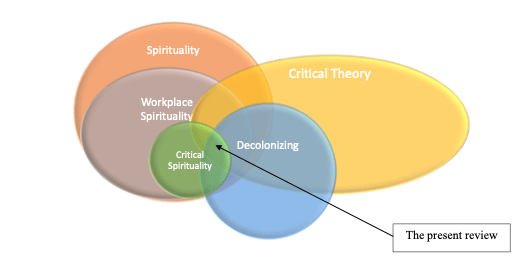
Workplace spirituality scholarship has explored key themes like sustainability (Sulphey, 2022), organizational performance (Garcia-Zamor, 2003), and critical theory (Wolf & Feldbauer-Durstmüller, 2023). However, a focused review of decolonizing workplace spirituality has been noticeably missing. Integrative literature reviews are especially well-suited to addressing this gap. By reviewing, critiquing, and synthesizing existing research, integrative reviews create new knowledge and suggest innovative theoretical perspectives (Torraco, 2016). Their wide scope and inclusion of both empirical and theoretical sources enable scholars to identify patterns, tensions, and emerging trends across disciplines (Wade, 2020). Because of this, the integrative review is an ideal tool for examining the theoretical growth of decolonized workplace spirituality. This review aims not only to describe current research but also to highlight gaps, particularly in the critical analysis of colonial capitalism, and to suggest future paths for interdisciplinary scholarship.
The first aspect of the framework, challenging colonialism, draws directly from Decolonizing Theory’s roots in lived experience and social movements (Lechuga & Aswad, 2024). Decolonization promotes self-determination and opposes the normalization of colonial power structures within institutions (Marsh et al., 2015). In a scoping review of decolonizing nursing education, Rosario et al. (2024) identified the sociopolitical challenge of decolonization as a key obstacle to transforming professional fields. Similarly, in a critical thematic meta-analysis of communication studies, Lechuga and Aswad (2024) contend that decolonization requires political and ideological shifts that lead to material, tangible organizational change rather than symbolic or metaphorical gestures.
The second river, empowerment and emancipation, flows from this same source. Decolonizing Theory emphasizes material emancipation and collective self-determination, a theme echoed in critical organizational spirituality research. Lechuga and Aswad’s (2024) analysis underscores that redefining decolonization epistemically and politically must lead to reparative outcomes within organizations. Empowerment, in this sense, is not an individual mindset but a structural reorientation that redistributes voice, authority, and resources.
The third river, reordering knowledge, challenges dominant epistemologies that favor Western rationality while marginalizing Indigenous and relational ways of knowing. Decolonizing workplace spirituality requires organizations to acknowledge multiple epistemic traditions and focus on the spiritual, embodied, and communal aspects of work. This epistemic shift disrupts managerial models that commodify spirituality and instead emphasizes context, community, and ethical responsibility.
The fourth river, self-awareness, focuses on reflexivity and Indigenous practices as ways to foster transformation. Growing awareness of positionality, power, and historical context enables organizational actors to address colonial remnants within themselves and their institutions. Together, these four rivers form a transformative framework for decolonized workplace spirituality.
In synthesizing this theory, the present blog series examines how Decolonizing Theory, CIT, and critical workplace spirituality intersect. The framework that emerges reimagines the workplace not just as a site of productivity but as a relational, ethical, and spiritually grounded space where healing, justice, and sovereignty are actively advanced. By integrating spiritual consciousness with political awareness and relational accountability, decolonized workplace spirituality creates new opportunities for organizational change grounded in justice, mutual respect, and Indigenous sovereignty.

