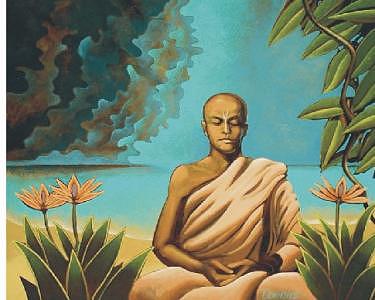
I want to live in a community of people mutually supporting each other and the common good through listening, growth, and stability. In short, I’d like to live a re-imagined monastic life.
Monasticism is a global phenomena having arisen independently on virtually every continent. What I mean here when I reference ‘monasticism’ isn’t so much the canonical boundaries, or the outfits, or the letters that can come after one’s name. Here I am talking about the act of ‘standing alone before God’ as the primary mode in which one understands themselves. This is important because it is the standing alone before God that no one can take away. That experience is what all human beings have in common. This reality compels the monastic to take reasonable action, such as prayer, study, and work, to respond to and prepare for the experience of standing alone before God.
In many traditions, monasticism is not the activity exclusively of hermits, but of communities of people. 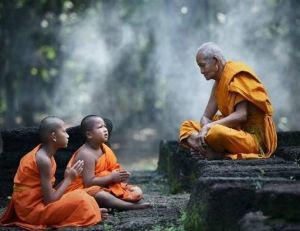 For example, we know that Benedict’s monastery had children and adults with developmental disabilities. Many Budhist monasteries have children present. A very many expressions of monastic life happen in community. All of the same dynamics, hazards, intractable frustrations, joys, and faults come into play in any community setting. Community is, necessarily, family.
I define monastic life as intentionally differentiated family life. This a way of ordering one’s self and one’s priorities. One can be a monastic and be placed in all sorts of situations: family, leadership, dish-washing, raising children. This monastic life is both a removal from the life of the world and it is plunging into the heart of the world. Someone with the priorities of maintaining a balanced inner/outer life may not nearly as often advance the corporate ranks. A person who stewards possessions and eschews ownership will not be motivated by a pay raise.
***
I look out my window and see a world that is in pain. Many people I know experience more isolation than they feel is healthy. Many people are depressed or anxious…. or both. Institutions are weakening and ways of life seem to be changing. The way forward for an American consumer or professional seems fraught. The identity of ‘consumer’ is especially pernicious in the United States.

People are free to choose everything from their food to their toilet paper. We all get to choose who we are with, how we will spend our time, and what we will own. We are each subjected to a steady stream of propaganda to compelling us to consume with the resources of artificial intelligence and the data we give it about ourselves.
Meanwhile, this consumption comes at a true cost to other people and the planet itself. Many say that they want the inequity and exploitation of people and planet to end but aren’t able to end their own personal behaviors that are unsustainable in the aggregate. It can seem to the honest observer that one must participate in the sins of the world to survive the vagaries of the world. This is no way to live.
I have been betrayed by institutions, both civil and religious. I see good people attempting to build power, a power that is to be used for cleaning up the messes we’ve made. Sadly, the power built seems to be rooted in and beholden to the systems and ways that created the messes in the first place.
A monastic heart and practice may be a path forward away from the status quo and toward a new and abundant life. 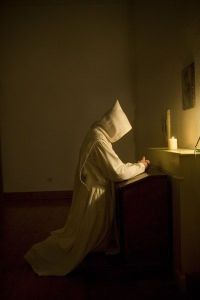 Benedict of Nursia, a powerful Christian monk from 1500 years ago, invited his readers to ‘Listen…… place the ear of your heart on the solid ground of the Master’s wisdom.” Equipping myself with the best resources available to serve my Master in nature and the others around me is my desire because it sounds like the most fulfilling way to live. This narrative of listening and growing in stability is the narrative I desire for myself, and one I hope to embody.
A life that gives life is possible. It only costs a reorientation of the heart. Let’s not delay, but run toward the abundant life waiting for us!
 Joshua David Kingsley
One thought on “Monastic Future”