
The book of Acts describes the actions of the people who had personally known Jesus, and their associates, after the Ascension. This group of people starts off as a small, mystical, economically diverse Jewish sect based in Jerusalem and the surrounding region keeping pretty much to where Jesus of Nazareth had traveled.
Then Paul shows up. Paul is this captivating character who is not really named Paul, but Saul. He’s a little bit of a book worm. Very smart. He speaks multiple languages, is a practiced in law and letters, and a life-long bachelor. He’s also a turn-coat. He switched 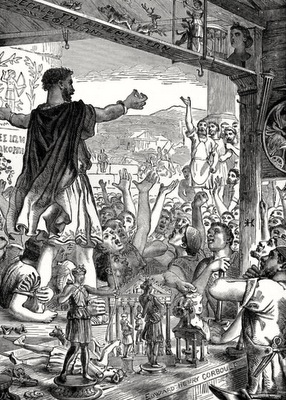 onto the Christian team after a mystical, woo-woo, life-changing experience on the road (Acts 9). Saul then says he is ‘Paul’ and claims to also know Jesus Christ personally. The folks who ‘actually knew’ Jesus of Nazareth aren’t so sure. Paul is a controversial figure and some people want to kill him.
Paul takes his show on the road, dirt-bag style. He gives up his law practice (Acts 13:1-3) and travels doing day labor (Acts 18:1-3, Acts 20:33-35, Phil 4:14-16) and organizing diverse spiritual communities in a bunch of different cities in the Eastern Roman Empire. In many cities to which Paul travels, there is some sort of riot or incident (Acts 16:16-40, 17:1-9, 18:1-17, 19:21-41, 20:23). Eventually, Paul is moved by the Spirit to return to Jerusalem. He wants to be there by next Pentecost to celebrate with his Christian friends (Acts 20:16). Paul’s arrival in Jerusalem sets off a chain of events that brings him into contact with the regional and then global political authorities where he is able to share his message of life in Christ and make a compelling case for a new world order. He is ultimately put to death, but not before he helped transform Christianity from a localized club to an empire-wide phenomenon. The arch of Paul’s journey to Jerusalem and meeting his eventual death has strong echos of Elijah meeting the chariot of fire (II Kings 2) and Jesus walking toward his death once he set his face toward Jerusalem (Luke 9:51, Mark 10:32).
Here is the thing. All along the way home,  God’s prophets and others filled with the Spirit tell him to avoid Jerusalem (Acts 21:1-12). It’s quite explicit and seems to read as a warning from God. Is the author of Acts trying to say that Paul walked into his death when it could have been avoided, when God was trying to warn Paul? Or is the message that we each must follow our own heart, complete our own story, even when it may seem ill advised to others? Or does the bible admit that clearly hearing from God is a messier process that it may sometimes seem?
Post what you think, or what you would do in Paul’s shoes below!


Josh My philosophy is naturally tainted by my background in human anatomy and physiology – and especially when it comes to the mystic/spiritual and .human.componants.My answer is a clear YES; please see the attached notes Blessings Grere PS: I was/am sad you decided to leave, I miss your spirit presence, but I also sensed tat your journey to God was a special one.Â
LikeLike