Intro: Have you ever been in a situation that gets ugly? Maybe it’s a breakup, or a fight. A NASCAR wreck or classic Jerry Springer episode. When things get ugly they aren’t good, that’s for sure. They’re too compelling to be ‘bad’ in a traditional sense. Ugly is part of a different continuum than good-bad. Ugly belongs on a spectrum with beauty. In a perfect form, ugly provides the photo-negative of beauty. We’ve seen the good and the bad. Now it is time to see Church: the Ugly.
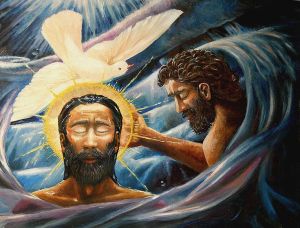
When John is baptizing by the Jordan, some Pharisees come to see him. They seem to be engaged in an argument regarding the source of authenticity. John is calling people to repentance and people are coming to him and confessing their sins, then undergoing a ritual bathing in the Jordan River (Matt 3:1-6). He indicates the source of authenticity is the inner drive toward repentance. Without his visitors even speaking, John contrasts the authenticity of his movement with the imagined argument of an appeal to authority as the sign of God’s Spirit and salvation (Matt 3:7-10). John’s prophecy about the end of their movement was partially correct. The temple was destroyed and the movement they persecuted became the world shaping Church. John advocates for God’s people being rooted in something more primal than organized religion: a personal interaction with the Spirit that leads to comprehensive balance. Religious power rooted in Empire will fall away.
The Apocalypse is a common element in many sacred stories. The Greek root of the word refers to an uncovering or a truth telling. For the last few millennia, that uncovering has been understood to entail also a destruction of the world as we know it. One could reasonably assume those who crafted most of the world’s religions understood that Deep Truth leads to the undoing of the human world as we know it. Sometimes it seems this has happened in a large way. The collapse of the Bronze Age, the genocide of the Indigenous Peoples of North America, and the Roman conquest of Gaul are a couple of examples of times where the world order collapsed for a large group of people. These sorts of times are uncertain, surprising, and often frightening.

Many of us have had a similar personal experience. A discovered affair reveals the ‘true state’ of a marriage. A job suddenly or unfairly ends and one discovers the parts of self that had atrophied under its weight. A sports team loses a game, or political party loses an election. One might wonder how could this happen, even though it happened honestly and must be reckoned with. This is an apocalypse. Faith, the love that powers it, and the hope that leads us on are three important tools for not only weathering the apocalypse but also making good use of it and rejoicing over it.
Where is the church in all this? The Christian faith has survived through a couple of apocalypses. Many in decision-making capacity feel it can weather this one in some form. As I have written about previously, the church has, for better and worse, crafted the world order we experience today. Outside of a few publicly nuanced stances, most religious organizations don’t say much different than one might expect to read in the New York Times, or hear on Fox News. Only the places where the Church has something unique to say or do will survive the next apocalypse. It will be ugly.

John’s Revelation (18:9-10) describes the kings of the earth who cry out at the apocalypse “Alas, alas, the great city, Babylon, the might city! For in one hour your judegment has come.” Theologian Wes Howard-Brook reinterprets the passage this way…
“Fallen, fallen is the global economy! For all peoples have drunk from its alluring cup, and the one percent have grown rich form the power of its luxury… And then I saw the corporate elite wailing and weeping, crying, “Also, our markets are no more!” And the banksters and their companions broke out in terrible lament, as all upon which they relied was no more… Alas, Amazon and Starbucks, Microsoft and Costco are no more! All the endless items available at a click will never be found again!” (pg. 297)
There are many material assets that embody the hopes and dreams of many generations that will be either given away or taken through attrition and corruption. I pray they are given to the inheritors of the great story of faith, regardless of their creed or affiliation. We are each a character in the story of Good Faith.
Sometimes a faith community is an amazing asset for weathering a personal apocalypse. Sometimes it is not all that one needs to grow through the trauma and crisis. Each of us can nurture the flame of our spirit. When it’s ugly out there and one is alone, they must be able to take responsibility, with God, for our own spiritual life and experience. When our church cannot provide all that we need, God will through grace. This may come in the form of a spiritual director, a good friend, or healing time spent in solitude.

This concludes a look at the Church: the good, the bad, and the ugly. Many great attributes of our world are because of the church. Much has happened in the name of the church antithetical to her stated mission. According to the Church’s own rhetoric, much of what currently composes the institution, the visible church, will fall away with the next apocalypse. What will survive is a remnant of people who know the story, know who they are, and can be about God’s business. This could be you.
***
Let me know what you think. Does Good, Bad, or Ugly resonate with you when you think about the Church or organized religion? Do you feel prepared for a personal or social apocalypse? Please leave a comment, subscribe, and share.
 Joshua David Kingsley
Wonderful article Josh! I have seen the good, bad, and ugly. However, fortunately my experiences have been good.
But most of all, my Savior Jesus Christ is the best thing that ever happened to me. Thank you so much for sharing your thoughts on the good, bad and ugly in the churches. God forgive us for the bad and ugly. And may we praise him for all the good. I love you, grandma Buff
LikeLike