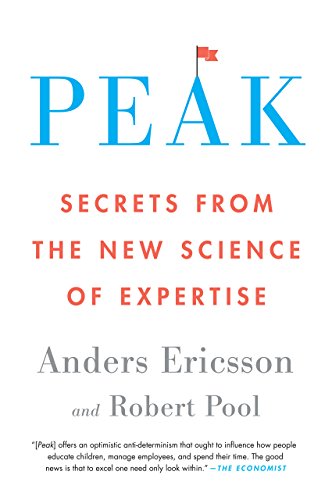
On the other side of the deep pool of spirit inside each person is the outlet, the acting out, their performance. Each person is malleable and adaptable according to their desire and will power. One’s actions and impact are the only worthwhile fruit of any inner work (James 2:14-26). Acting with intention in a way that clearly communicates a purpose is performance. Performance can be studied, honed, and expanded. It is the study of performance Anders Ericsson considers in Peak: Secrets from the new science of expertise.
Using case studies of people memorizing random strings of numbers, Ericsson begins to describe how highly concrete, long studied fields with a high degree of consensus of accurate performance (music performance, chess, sports, etc.) hold some clues regarding how people intentionally improve a skill. These clues include…..

Power in Practice
Practicing something is essential to maintaining a skill let alone improving it. Not just any kind of practice will do, however. There is a certain kind, a very mindful, deliberate practice that is slow and has an intention in mind. Only this kind of practice will help a person get to their destination. This purposeful practice requires getting feedback and moving out of one’s comfort zone.
Keeping our Potential Alive
The human brain is a fascinating organism in its ability to adapt, imagine, and imitate. Like many physical aspects to the human experience, without continued learning and development, the brain begins to fall apart and wear down. That said, so much human potential exists that a person could be always learning, always growing. Harnessing one’s adaptability feels good and fulfilling,

Developing the Mind
Mental representations play a key role in an individual developing a skill. These representations are large collections of information (groupsets) analogized or made into a story for easier handling and storage in long term memory. These mental representations make possible “memory, pattern recognition, problem solving, and other advanced abilities needed to excel” (pg. 63). The better in quality and more in quantity of these representations, the more one can excel in a skill.
Deliberate Practice
In the end, we much each approach our craft alone. This is certainly true of the kind of practice that helps people excel to the top of a given skill. All the evidence points to solitary, personal practice being the key differentiator between the good and the great. That’s not all. This practice must be deliberate. Deliberate practice is purposeful practice (feedback and discomfort) is purposeful practice, with a conscious and continually refined set of mental representations, that has a clear and concrete goal. This kind of practice focuses on skill rather than understanding or knowledge.
Applied
Deliberate practice can be applied in the public and private sphere. To do this, one needs to both continually update their skills through a reflective, challenging practicing community. Additionally, one needs to be always improving their mental representations, keeping the robust and multi-facited.
Finding a good teacher helps. Very few, if any, people improve significantly in isolation. With a plan, firm engagement, and a community of support, consciously developing and refining one’s skills is one of the most powerful ways to improve the effectiveness of one’s practice.

What Now?
Ericsson is clear that anyone, regardless of age, has the capacity to grow and change. He says, “While the adult brain may not be as adaptable in certain ways as the brain of the child or adolescent, it is still more than capable of learning and changing”. Regardless of any natural-born abilities, the ability to engage in deliberate practice, tolerate a certain level of discomfort, and be involved in a practicing community give anyone a good shot at being great (or a great shot at being good) at almost anything.
What happens when this understanding is applied to the spiritual life? Can a spiritual practice also have elements of deliberate practice? A deliberate, spiritual practice?
I have written about the importance of one’s spirit, and spoken of how people living intentionally out of their spirit is a documented global phenomena. That is to say, it is a naturally occurring phenomena. Spiritual practice requires some outlet of action effected through the changing of our hearts. Each spiritual practice is beautiful; it deserves an excellent, well practiced set of skills through which to come express itself. Deliberate practice is a deeply loving gift to compliment our inner practice.
How do you practice? What do you practice? Please comment about how your spiritual life comes out through action.

