What is happening when someone sees a vision or dreams a dream? To be sure, many are the times that a cunning person has beguiled the simple yet earnest person by ascribing dubious actions to a vision or dream without basis. We must hold, however that some visions and dreams are a real experience on behalf of the seer. In these cases, what is happening must be able to be understood as a natural phenomena. In these dreams and visions we observe archetypes that exist both in our personal unconscious as well as resonate with a global “collective” unconscious. Many make the case that by exploring our dreams and visions (our personal mythology), along with analyzing global mythology, a mythological pattern emerges that describes the human journey aligned with Nature. The story of Jesus Christ fits within this pattern making Christianity a retelling of an history-old story of human struggle and triumph rather than a unique, original tale.
The world of the unconscious (dreams, visions, fits of rage, etc.) has long been a mystery and controlling factor for humans. In ancient near east literature, the chaos of water is used to symbolize and describe the terrible monsters, surprise storms, and general dangers of sailing past the horizon, into the human unconscious. We can look to stories of the flood, or even to the Disney movie Moana, wherein the received wisdom of the tribe is to not journey into the sea for salvation because the risks is simply far too high, even with crop failure in progress.

For much of early psychology, the unconscious was viewed as a sort of attic where unwanted, dusty odds and ends were collected and then came our in our dreams. It’s not until the work of Carl Jung that similarities and patterns are documented between the unconscious of different people. Jung puts forward the idea that all unconsciouses are connected into a collective unconscious (1). This collective unconscious is made of the hearts and dreams of each of us, in the same way a wave in the ocean is made of many molecules of water, which individually may not even be aware they are part of a wave. Many of us living through COVID and political upheaval may find the idea of a collective unconscious to sound very practical.
It is postulated that within this unconscious lives archetypes. These archetypes are essential information for our individual and collective survival that take the shape of hero, villain, warrior, lover, etc. Nietzsche supposes that “in our sleep and in our dreams we pass through the whole thought of earlier humanity” by encountering the wisdom of our ancestors in archetype (2). Boas postulates that our shared archetypes lead to common characteristics and values that are “the same all over the world” (3). Freud attests that “this symbolism is not peculiar to dreams, but is characteristic of unconscious ideation, in particular among the people, and it is to be found in folklore, and in popular myths, legends, linguistic idioms, proverbial wisdom, and current jokes…” (4). Carl Jung goes the farthest to state directly, “archetypes are the unconscious images of [human] instinct itself.” They are “patterns of instinctual behavior” passed on by our ancestors that we are compelled to act out for our survival (5).
A standard journey for the hero to make is some variation of seperation-initiation-return (6). It goes like this: A hero is called upon a journey from the realm of mere mortals and becomes a spectacle of greatness evidenced by bestowing grace, sustenance/healing, or Spirit.

This spectacle sets up a conflict with the forces of chaos and darkness. This conflict is the initiation to a transcendent reality. Once initiated, the hero then returns ‘home’ with power to bestow to others.
Christianity is a cult based on the historical Jesus of Nazareth who was elevated to the title Jesus Christ. Christ means the source of life, or the umbilical spot wherein the Great Spirit flows into the material or human world. Christ had difficulty tolerating the world, and the world him, setting up the ultimate conflict of his crucifixion. The crucifixion serves only as an invitation, however, as Christ comes back ready to bestow the Holy Spirit on his followers.
This is called ‘The Greatest Story Ever Told’. Consider the similarities between Christ and Odysseus. Odysseus leaves on a journey from the Trojan war, where he had been separated from his family and proved his mettle. On his journey home, many challenges are faced from disobedient crew, to seductive women, to monsters. Having been initated through the trials of his journey, Odysseus returns home to share his justice and rule by evicting uninvited suitors and the spoils of his journey.
Or, consider the story Gautama Buddha. Seeing the suffering of the world he leaves his royal palace and retires from the world (separation). While living as an ascetic monk he faces many hardships of fasting and submission to the elements (initiation). When he had reached the end of his searching through initiation and sits under the bhoddi tree he attains enlightenment and becomes a bodhisattva, the living Buddha who shares enlightenment with all living creatures.
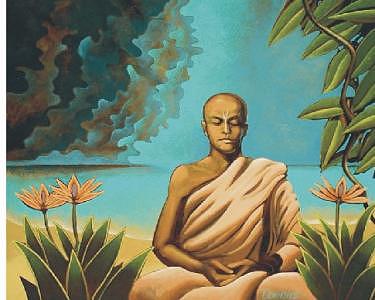
The settings are different. The values espoused vary slightly due to culture. the arch and purpose of the journey seems the same. In the stories of Abraham/Sarah, Moses, Christ, Mohamed, Odysseus, Buddha, Odin and Baldr, and many others, we see this story play out always in an exciting way, always the same story. These stories, and many others not mentioned here, illustrate a larger ‘monolith’ articulated by nearly every culture for which we have a record. This arch and reality has implications for the Christian enterprise and our personal journey.
The cult of Christianity can no longer claim an original or exclusive message. Any truth in Christianity must have been accessible before Christ and in other cultures. Indeed, it was never Christ who made this claim of exclusivity, rather his followers after his death. Instead, Jesus speaks of many flocks (John 10:16) and is often empowering people who are not his disciples (Luke 10). The Church is attempting to be the gatekeeper to a state (heaven) that has not gates or walls. As such, she is acting as a block for people on their way to enlightenment. As Lao Tzu (38) reminds us,
Lose the Way, and virtue follows;
lose virtue, and compassion follows,
lose compassion, justice follows;
lose justice, and propriety follows
Propriety makes a veneer of loyalty and sincerity, and discord sets in.
You are the one who must live with your journey. No organization or institution bears responsibility for your soul. The wisdom of human archetypes lives in you. The goal is to uncover it, rather than instill it. Uncover this wisdom with friends, the people who care about you without external incentive. Subscribe to this blog to be plugged into a community of people uncovering and living into the truths of our shared wisdom. You already have it within you.
***
(1) Jung. Psychology and Religion, par. 89.
(2) Friedrich Nietzsche, Human, All To Human, vol. I, p.13.
(3) Franz Boas, The Mind of Primitive Man (1911), pp. 104, 155, 228.
(4) Sigmund Freud, The Interpretation of Dreams, translated by James Strachey, Standard Edition, V, pp. 350-51.
(5) Jung, The Collected Works, Vol. 9 Part 1, Trans. by R.F.C. Hull, (2014), p. 44.
(6)Joseph Campbell, The Hero with a Thousand Faces, (2008), p. 23.
 Joshua David Kingsley